Also known as the GamezMama, I’m a professional board game teacher and designer. Black Bear Creation is my new publishing company and we’re looking to publish our first game, DEER! in 2026.
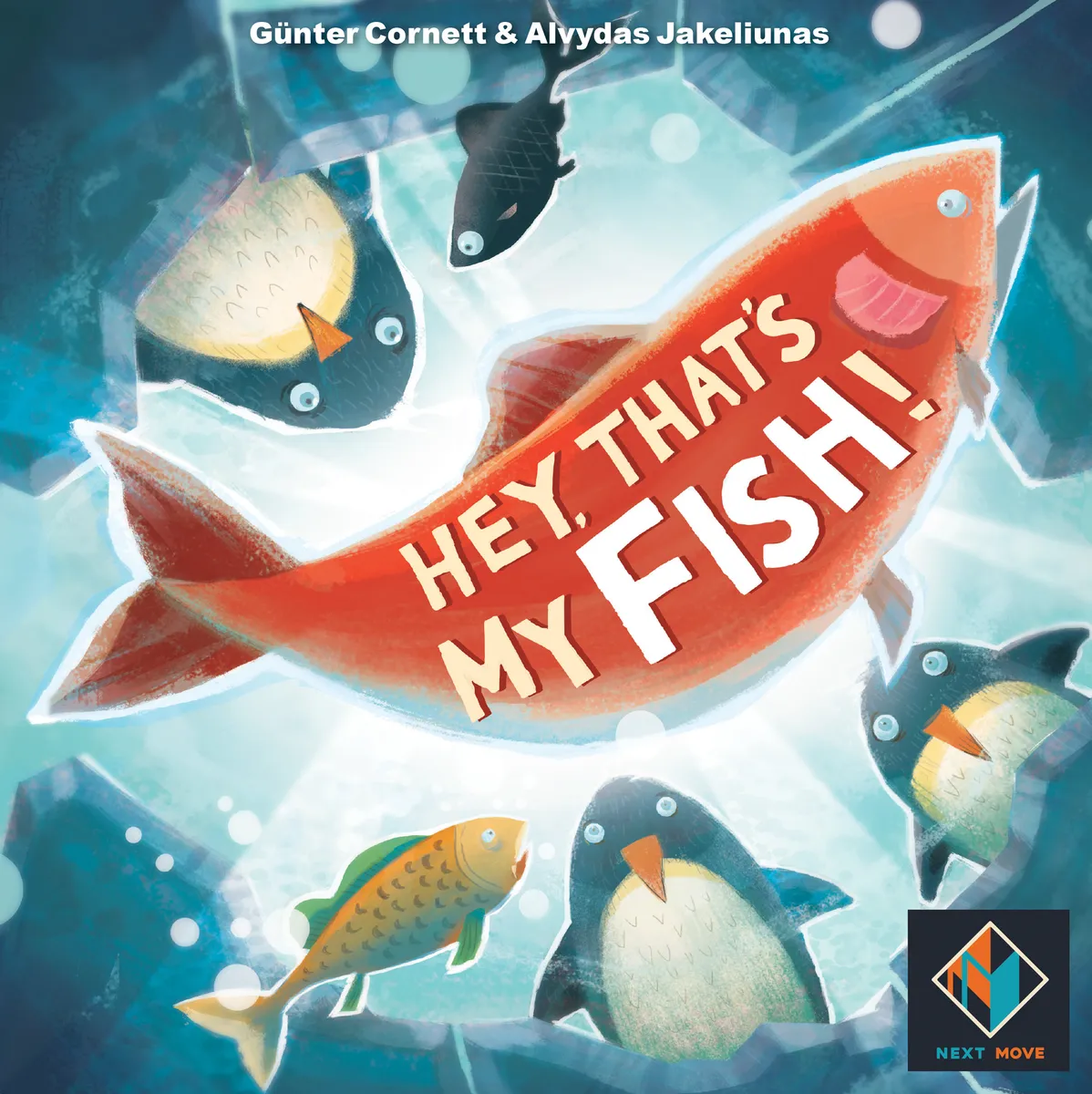
Published first in 2003, Hey, That’s My Fish just recently got a new edition on 2023, which was published by Next Move Games, designed by Gunter Cornett and Alvydas Jakeliunas. It was added to Board Game Arena on March 15, 2026.
It plays 2 to 4 players, in 20 minutes.
In Hey, That’s My Fish!, players take on the role of a group penguins, collecting hexes of ice floe with fish on them. Each fish is worth one point and the player with the most points at the end of the game wins.
The number of penguins a player has is based on player count.
On your turn, you move one of your penguins in a straight line, collecting the tile it started on from the hex grid, slowly shrinking the grid. Penguins can never move through another penguin, or move through a hole in the ice.
Strategically, it is beneficial to strand your opponents penguins on small, isolated ice chunks to prevent them from collecting more fish. Once all penguins are eventual left on just a single piece, the players count up all those tiles as well. Any additional tiles that were isolated and unable to be reached by a penguin are discarded.
The player with the most fish at the end of the game wins.
On Board Game Arena, the tutorial is written by the prolific Nekonyancer. The tutorial is quick, easy to run though and gives a very solid understanding on the rules of the game, as well as the couple alternate play rules that can be use on BGA.
Hey, That’s My Fish is a premium game, which requires the Premium Membership to host tables of this game, but a player could join a game hosted by a Premium Member. I appreciate the model that Board Game Arena continues to keep, making it easy for one person in a play group to hold a membership and host games for everyone else.
The game itself runs pretty smoothly on Board Game Arena and I didn’t have any trouble with it.
Hey, That’s My Fish! is a fun and quick little filler game. I own the old Fantasy Flight version, that came in a small square box with plastic penguin miniatures in player colors. I have not played the physical version of the new copy.
This is a fun, easy to learn, and short game for families, casual gamers, and kids. The penguin meeples or miniatures, depending on which version you have are adorable and lends to the cute and light appearance of the game.
Gameplay provides a light strategy feel, with turns that give players the opportunity to feel smart about it. It can also end up being a little mean when trying to cut each other off and blocking opponents out of larger sections of the ice floe. The fact that is typical a short playtime, helps that little bit of aggressive player interaction.
I have previously rated this one on Board Game Geek as a 6/10 and I stick with that. While it’s not one of those games I suggest often or keep with me, it is a game that I keep in my collection and break out with family or my son from time to time.
The implementation on BGA is a fun, quick, and easy to understand experience. The settings on the game give you the option for real-time or end of game scoring, as well as additional map set-ups and variant rules.
Alright, I know I’m pretty slow at this, as we are now in January and this event was in November, but kids man, the take a lot out of me, especially with having Thanksgiving and Winter Breaks being practically back to back. However, I’m back with the rest of that weekend.
Living Forest is a game that I fell in love with on Board Game Arena. I had bought a physical copy a while back, but wasn’t able to get it to the table, so it was still in shrink when I brought it with me to Friendsgiving. On Friday morning I was able to introduce this game to friends.
This game is designed by Aske Christiansen, art by Apolline Etienne, and published by Ludonaute.
In Living Forest, players are nature spirits trying to save the sacred forest from fire. The game ends when one player reaches one of three possible goals: putting out 12 fire tokens, collecting 12 sacred flower symbols, or planting 12 protective trees in the forest.
At the beginning of each round, players will draw animal guardian cards from their deck, pushing their luck until they decide to stop. In your deck there will be dark creatures that will give you darkness symbols and if you ever pull three, you bust. If you don’t bust, you get to take two actions on your turn, but if you do bust, you only get to do one.
Your cards are important though as they have the resources you use to do actions. There are four actions in the game.
Sun icons on cards and in your forest will give you the ability to bring new sacred animals into your forest, increasing your deck size. Be careful though as each animal card you gain, more fire tokens will come out next round. The more powerful the animal, the bigger the flames. You can find animals in the forest that will give you light symbols that counteract the darkness. Or you can find animals with more darkness symbols, but they have a lot of good resources, so you have to find a good balance.
Water icons will let you put out flame tokens in the middle of the forest. Each token might need multiple water symbols to clear it, but only count as one towards your goal of twelve.
Plant icons will allow you to plant trees into your forest. These trees give you permanent resources each round. Covering rows or columns will give you additional bonuses and there are special spaces you can cover for additional actions.
Then the spiral action lets you move your spirit around a track on the center board. This track will have spaces on it that do the other three actions, but you’re also moving around the other players. Each player starts with one token of each of the three scoring types. If you hang onto them, they score you one of each type, but as you jump over other player’s spirits, you can steal one of their scoring tokens, increasing your score.
I really love this game. It is light, fun and simple, but with an engaging push your luck element. I typically find that most push your luck in game punishes you if you play it safe. However, if you play strategically and accumulate symbols in other places or gain cards that decrease the darkness, you can still play a competitive game.
After Living Forest, I got into a game of the newest Vital Lacerda game, Speakeasy! I was really excited about this one as I have enjoy most Lacerda games I’ve played. Art by Ian O’Toole and published by Eagle-Gryphon Games.
With how new it was, there wasn’t much in good teach videos online for it just yet and the person who brought it hadn’t played it yet, so we struggled our way through the game, but it was still a ton of fun.
In Speakeasy, players take on the role of managing their own Speakeasy operation in Prohibition era Manhattan. Players must watch out for the police as they close in on all the neighborhoods and combat the mob who have their own operation.
This game mixes worker placement and card management as you work to set up your own Speakeasys, Still, and larger clubs and casinos. You start with four workers in the first round and then quickly drop down to just one worker in the last round, as you send them to action spots at the top of the board. You will be building out into different areas of Manhattan, producing alcohol at your still, buying it from ships, or even stealing it from ships, then transporting it to your buildings.
You’ll also have the ability to play cards from your hand that give you a special action and a standard action depending on the color of the card, then slot into your player board, giving you ongoing actions.
Players will accumulate money in their bank, that they cannot really use, unless they launder it at a loss, but will be points at the end of the game, or money to their operation that they use to build and do actions. It’s a fine balance between having the money to do the actions you need and accumulating points.
The description here is pretty vague, but it was a first play-through and I haven’t gotten in another play yet, but I’m looking forward to exploring the game further.
This one is a 9 out of 10 on Board Game Geek for me and I’m eager to get a copy and play more.
Friday night we had Friendsgiving dinner, which was so delicious and surrounded by amazing people. Then after dinner I got to jump into a game of Dinosaur Island with the Totally Liquid expansion.
I was one of the original Kickstarter backers for Dinosaur Island when it originally was published, then had also backed the Totally Liquid expansion. My husband and I had played the base game several times, but hadn’t gotten the game with the expansion to the table before it became a Covid casualty and was sold. Dinosaur Island is a massive table hog and we just didn’t have the table space of it at the time.
Dinosaur Island was published by Pandasaurus Games in 2017, designed by Jonathan Gilmour-Long and Brian Lewis, with art by Kwanchai Moriya and Anthony Wocken. In this game, players are running their own dinosaur park, researching and collecting DNA to bring dinosaurs back to life as exhibits in their park. It sounds an awful lot like a certain movie franchise.
Play is broken up into multiple parts during a rounds.
During the first part, players will draft DNA from dice rolled at the beginning of this part, research dinosaurs to add to your park, or expand you cold storage so you can hold more DNA. The second part, players will gain worker locations in their lab, workers, or attractions. Then last part is worker placement to spend DNA to create dinos and other worker actions. At the end of each round, people visit your park and you hope your security is greater than or equal to your danger level so no one gets eaten.
The Totally Liquid expansion added aquatic dinosaurs and other modules, but we just played with the new dinosaurs and none of the modules.
This game is still a lot of fun, it’s just a beast to table and play. When I originally owned it, I rated this one a 9 out of 10 on Board Game Geek. Since 2017 however, I’ve delved super deep into heavier games and my tastes have changed some. I still really enjoy this game, but it’s dipped down to more of an 8 out of 10 for me. Not a significant drop.
Don’t Let It Die is a 1 to 4 player cooperative survival game where the players are a team of neanderthals that have found a fire, courtesy of a lightening strike. The goal is to keep the fire alive, survive, and research as a group to uncover the secrets of fire within 14 days.
The game is designed by Dustin Hendrickson, with art by Samuel Milham, and published by Thunk Board Games.
After selecting a team of four characters (no matter the player count), players spend stamina points to Investigate Fire – rolling a die to determine how many fire knowledge points are earned, craft weapons and tools, use skills, or draw a gather, forage, harvest, or hunt cards.
The goal of the game is to survive, keep the fire alive, and discover the “Fire Starter” technology before 14 days elapse. Players can loose the game by the fire going out, all characters being incapacitated, or not discovering fire before 14 days are up.
Gameplay is fairly straight forward, but the different combinations of characters and their abilities to successfully achieve your goals.
The tutorial is written by Nekonyancer and is well done, as I have found most of their tutorials to be. It gives the rules and helps to convey the strategies for playing the game. The tutorial ran smoothly.
I am not particularly a huge fan of cooperative games where the goal is just to meet specific achievements. Give me a cooperative story game all day long. But this an your standard Pandemic ‘style’ of games just don’t keep me engaged in the same way as other games.
And while I know that a ton of people enjoy the pixelated style of art, it’s just not for me.
So overall, this was a bust in regards to games for me, but not a bad game. It just depends on your preferred play style.
I’m rating this one at a 3/10 on Board Game Geek, for me. Your mileage may very!
Wandering Towers is a game designed by Michael Kiesling and Wolfgang Kramer, with art by Michael Menzel. It is published and available here in the US by Capstone Games.
This is a game that I am highly familiar with as I work with Capstone Games at conventions and sells tons of copies of Wandering Towers.
In this game, players will take turns playing cards to the middle of the table then moving either their wizards or any of the towers.
The point of the game is to get all of your wizards in the dark tower, Ravenskeep, and fill all of your potion bottles.
Fill your potion bottles by using a tower to cover any wizard (yours or your opponents), which fills exactly one bottle- no matter how many wizards you cover.
Each card has the potential to move wizards, towers, or picking one between the two options, with a value of movement between 1 and 5. Cards can also show dice, which allows you to roll a die and use that value. Play always moves clockwise around the board.
Anytime a wizard reaches Ravenskeep – using the exact number of spaces, but if they go over, they will move past it – the tower will move to the next available Ravenskeep symbol on the board or on the top of a tower. If the tower or board space had wizards, it’ll skip that space.
Keep chasing Ravenskeep around and hiding wizards under towers until one player meets the end condition and the game is over.
The tutorial for this one was created by Scribal, but I had to end up quitting out of the tutorial because I hit a point where despite doing the correct action, the tutorial error-ed out and wouldn’t progress. I did try to restart the tutorial and go through it once more in case it was on my end that I clicked something wrong, but it had problems at the same point. Disappointing, but the game is super simple and straight forward and the rulebook is fine.
This game is a lot of fun, easy to learn, and light enough for family gaming and game nights. The physical game is definitely worth it for the table presence of the towers building up.
I am not as keen on it on Board Game Arena for exactly that reason as well. As you can see in the screenshot, the top down view works, but it doesn’t give the same ease of remembering and visualizing which levels your wizards are hidden under. You can tell me the tower is 7 tall, cool, but unless I’m looking at it, my brain can’t remember it the same.
I’ll keep playing the physical game, but probably won’t return to the BGA version. If you’re thinking about it and the kind of person that will only buy a game if they’ve played it, then Board Game Arena it a great place to do that. Don’t let the visualization of the BGA version deter you if you like the gameplay though.
I rate this one at an 8 out of 10 on Board Game Geek. It’s not my standard big heavy game that I love, but it’s a super great game for kids and family.
Cookie Addict is a small box tile laying game for two players by publisher Lubee Edition. The designer is Pierrick Lugen and artists Alexandre Brull and Martin Maigret.
In this game, players are either the fox or the racoon that have escaped their enclosures at the zoo. They are competing to collect the most cookies while avoiding the zookeepers.
Players construct a 6 x 6 grid of tiles that had different amounts of cookies, decoys, and special tiles. Orient the tiles so that they are all facing the same direction, as this helps identify where each players places their character pawn.
The fox will play first, placing their marker next to one of the rows of tiles, on the right side of the play area. The row they indicate with their marker is the current active row.
Next the raccoon will place their marker, underneath a column at the bottom of the board, the marker indicating the column they want to activate.
Why is it important that the fox place on the right and the racoon place on the bottom? This placement will result in a single square in the grid being activated in both the row and column each turn. That square is the square that player activated. Once a square is activated, the player that activated it collects the reward or loses cookies if it was a negative, then flips the tile over to the dark side, as the zookeepers continue to search zones.
So, look at the image below. It is the Fox’s turn to go next. The Fox is somewhat limited, because their previous turn left them in the bottom row – so they cannot stay there as the tile is already flipped – and the top two tiles have been flipped. Their option is to play in row 3 (counting down from the top) and lose one cookie, row 4 and lose two cookies, or row 5 and gain a cookie and a decoy.
The main strategy of this game is to collect the most cookies while trying to kept your opponent from winning. Cookies are victory points, while decoys allow you to move the zookeeper marker. The zookeeper is currently in row 1 / column 5. The zookeeper marker blocks a space, but can be moved if you have collected any decoys.
The game keeps going until one of the two players no longer have a valid move for their marker, or one player manages to trap the other into taking the ‘instant capture’ tile, which is the top right tile in the image above with the zookeeper truck on it and the skull.
The tutorial for this one was created by gideon142 and is an okay tutorial. It teaches the concepts of the game well enough that it allows you to get playing. However, the directions given for where and how to place your token so that the tutorial progresses weren’t always great. There was one point when the creator told the player to place their marker so that it intersects with the top left tile, but it meant the top right tile. When I couldn’t place the marker to execute the move as the written instructions provided, I was able to look at the visuals in the tutorial to see where the confusion was. Long story short, it’s enough to get you into an actual game.
Cookie Addict is a fun little two player game. It is an abstract strategy game, which I’m mentioned that I’m kind of hit or miss on. One of the things that I like about this game is that the grid set-up is going to be different each time. Players will create the grid with a combination of cookie tiles, lost cookie times, and a random selection of special tiles, so games are going to feel different and not have a solved element or a definitive right answer in how to respond to another player’s actions.
The theme and the art is absolutely adorable. I love the ideal of playing the role of an escaped racoon or fox just out there trying to get themselves some sweet treats and avoiding the zookeeper.
I think the addition of the zookeeper tokens and the decoys to facilitate moving the zookeeper is great. It gives players a way to manipulate and block their opponents into making specific moves. But you don’t just get the ability out of nowhere, you have to go to a location that gives you decoys, which also usually gives you less cookies, as you’re getting a different type of resource.
I found the ‘Auto Lose’ Zookeeper truck trap to be pretty brutal, that even if you are ahead in points and your opponent manages to trap you into that spot, you just automatically lose the game. If I owned a physical copy, I think that is one tile that wouldn’t be put into play unless the players were both equally good a the game, but there are more than enough special tiles to play with, so it’s all good.
I enjoyed this one and it was fun. Probably not one I’d own, but will stay in my favorites on the website and willing to play it on Board Game Arena with others.
Coatl, published in 2020, by Synapses Games, was designed by Pascale Brassard and Etienne Dubois-Roy, with art by SillyJellie.
This is a family level abstract strategy game with a fun toy factor in the plastic serpent pieces.
While I played this on BGA, you don’t get the same table presence and toy element as the physical version would.
In Coatl, players will take turns taking actions, accumulating prophecy cards and Coatl pieces in order to work towards building up to carve intricate Coatl sculputre (a Coatl is a feathered snake) to please the gods and attempting to score the most points and win the game. In this game, players take turns, taking one of three actions each time. The three actions are to take prophecy cards from the display, taking an available serpent pieces (head piece, tail piece, or pair of body segments), or assembling part of a Coatl.
Prophecy cards provide scoring objectives for the Coatl, based on specific color patterns and potentially how many times that pattern shows up in the serpent. Additionally, there are temple cards with similar goals. Each player had their own ‘private’ temple card for scoring, but can also claim one of two face up temple cards that are publicly available if they meet the conditions, when they complete one of their Coatl.
Each player is limited to eight pieces of the Coatl (head, tail, and body segments) before they must start assembling a serpent in order to open up more space for additional pieces. The Coatl can be placed during multiple assembly actions. Each will have one head, one tail, and any number of body segments. The Coatl is only finished when both the head and the tail has been placed. Prophesy cards can be added before the Coatl is complete to score, with one Temple cards being able to be scored during the turn a Coatl is completed.
Once a player has completed 3 Coatl, the end game will trigger. The round will complete, back to the first player, then each player will get one more turn. The player with the most points at the end of the game win.
In this one, the tutorial was created by thunder0491. The tutorial was very straight forward and taught the important concepts of the game well. The one thing that could have been more clear, is that even though the Prophecy cards only show body segments, the head and tail segments do count for the patterns.
This one was a fun and enjoyable game. Super light and super family oriented, but it made me think a little bit deciding which cards to take, which serpent pieces select and how to assemble the Coatl. This definitely would show off that toy factor more in a physical copy of the game. but it plays well on BGA.
This might make it to my list of games to get a physical copy of, as I think that my 8 year old would be able to play and enjoy this one.
I’m rating this one a 6/10 on Board Game Geek. It just falls a little too much on the lighter side for me to be a frequently played game, but I think this is a great game for families with kids in the 8-15 or so age range.
Medu is a 2 player abstract strategy game, published in 2025 by Mindcastle Games. The game was created by Thai designer, T-raz Bank Piamdumrongsak.
In this game, each player starts with a set of tiles the same as their opponent. You have size 1 through 4 of tiles, in four different colors.
On your turn, you must play a tile to the board.
The first player will have to start with a tile of a specific size, determined by their opponent. Following that, players must match either the color or the size when they place their next tile. There are limited spaces on the board, being a 4×4 grid, however, a piece can be placed on top of an existing piece as long as the new piece is smaller than the piece it is being placed on top of.
The goal of the game is to get 4 in a row of the same number or color, 4 in a row of all different number or color, 4 in the same space, all same color, or 4 in the same space all different color. The first player to achieve this wins the game.
The tutorial for this one was created once again by Nekonyancer. All of their tutorial typically get a 4/5 or 5/5 star score from me. They provide the relevant rules and necessary information in a quick and well presented way. Jumping into a game following this tutorial was easy.
This is a pretty straight forward two player abstract strategy game. The rules are simple, but the execution of the game play and the strategy provides strategic depth to the play of the game.
It is exactly what it advertises itself as. I don’t typically have strong feelings on two player abstract games. This one is fine and if you like this style of game and it does something different from other games you have in your collection, cool. I’m pretty in the meh zone on this one.
I probably won’t play additional games of this one. It just doesn’t do enough to engage me.
Asteria is a two player, 4X strategic card war game, where players compete to achieve several potential victory goals while playing cards to Extract, Expand, Explore or Exterminate on a range of planets, competing for dominance.
The game is designed by Augusto Rocha, published by Brazilian company MeepleBR, with art by Harpy Studio.
It was added to the Board Game Arena catalogue on December 10th as part of the Winter of Game event.
In Asteria, players are fighting for control and trying to score three points by achieving various potential objectives. Players can outright win with a Military victory by controlling three planets, or piece together their three points through a combination of Exploration, Technology, or Economic. Any combination of the four goals that equals up to three or more points will do it.
Players draw from a shared deck of 38 action cards, each card having an Extract, Expand, Explore, or Exterminate option along the edges of the card, providing different abilities and different combat values. On their turn, a player can play one card to each of the planets in the center of the table.
The Extract ability of each card gives resources at a zero cost, though typically can have negative combat effect. The remaining three aspects of the cards will cost you the resource amount of the card to put into play.
When a card is played to a planet, that player will either place or increase their expansion marker along the combat track for the planet. When both player’s expansion marker meet along the track, a combat will take place at the end of that turn. A couple of factors can influence the outcome of a combat, but the player with the highest combat value will end up winning.
Play will continue until one player achieves the three victory point threshold and ends the game.
The tutorial on BGA for this game was created by Nekonyancer. The tutorial is a great way to learn the core aspects of the game and get you started. After running though the tutorial, I was perfectly confident jumping into a queue and playing in a game.
The Board Game Arena implementation is easy to use and work through the different part of each of the turns.
This has been a fun game and I’ve enjoyed it. If you like 4X style games and two player head type games, that this will definitely be something you’d want to check out. I like the aspect of playing the cards to the planets and deciding which aspect and ability of the cards to play when gives the game strategic depth.
For me, this is probably one that I won’t revisit much. Typically, two player only games aren’t my style, even though I mainly play many games at two players. I’m typically more interested in games that allow me to stretch my legs and try different realms of strategy.
In this game, while there are going to be a wide range of card combinations played to the different planets from both players, creating unique combinations and a different game experience, the pathways of this game will always be trying to win planets towards a Military victory, while also trying to pick up an additional points along the way.
As a small game, it does what it should do and does it in an engaging way, its just a little to small and constrained for my tastes.
As such, I am rating it on Board Game Geek, a 4/10. Not my style of game, but not a bad game.
Quattuor Reges, is a 2 player, head to head, chess style game, designed by Gauthier Fourcade. In this abstract strategy game, the player pieces represent cards from a deck, between 7 and the Ace, in the four suits. Each player controls two of the suits, either as the red player or the black player.
The goal of the game is to get an Ace, King, or Queen to your opponents back line for the victory.
The method of capturing pieces is based on a circular value, rock-paper-scissors style method. Aces can capture all Faces (K, Q, J), Faces and Higher Numbers can capture the small number pieces, but then any small number pieces can capture an Ace. Then there are specific rules for each group, creating a circle of winning values.
All of your pieces can come 2 spaces in any direction, but cannot jump other pieces, except for the 9, that moves 3 spaces, and the 8, that moves 4 spaces, and the 7 that moves 3 spaces, but can also capture the Jack. The finally ‘trick’ is that a player can move two pieces on their turn, but they have to move one from each suit, so it’s important to position you pieces well.
The tutorial was once again done by Nekonyancer and was well done. It allowed the player to activate and manipulate the board while teaching the concepts. Once the basis concepts were taught, as it’s an abstract strategy game, they also taught a little bit of strategy to consider.
This is not my kind of game. I don’t enjoy chess at all and this is very similar vibes. While I do enjoy abstract strategy games that do things different, this one is just too close to chess, the movement rules are varied enough to be hard to remember as a beginner, then the values that beat other values needs constant reference. While a reference card is easily accessible, it didn’t really help much.
The number values that more further seems arbitrary. On Board Game Arena, it shows you where you can move when you click a piece and even where your piece is in danger if you move there, but in a physical version, you don’t have those kinds of features.
This is also the kind of game where someone with superior knowledge of the game very easily stomps a person trying to learn (much like my previous experiences with chess). If you like chess variants, this might be for you, but it’s definitely not for me.
I am rating this one at a 3/10 on Board Game Geek. Based on the BGG scale, this is generous and rates it as “Bad – likely won’t play again”. I definitely won’t be playing this again, but I’m also not going to slam a game based on my personal preferences. I don’t know that I think that the gameplay is Awful or Very Bad (which are the 1-2 options), it’s just not my kind of game and I won’t be revisiting it.
If you’ve played it or you do give it a try, let me know what you think!
Moonlight: The Land of the Wolves, is a 2-player head to head game, designed by Alexandre Aguilar and Thomas Favreliere, with art by Noemie Chevalier. This game was published in 2025, by French company La Boite de Jeu.
In this game, players are taking on the role of opposing packs, battling for the control of the mountain territory through the use of card play. The goal is the have the most points to win a round, and the first player to win two rounds wins.
Players each have their own matching deck of eleven cards, with strength values 1-5, used to claim position in a 4×3 or 3×4 card tableau. On their turn, players will play a card out into the grid and then draw a card into their hand. Once the first card has been played, players must continue to play adjacent to an existing card, or they can cover up one of their opponents card, if the strength value is exactly 1 higher than the card in play.
The round will continue until the grid is full or players run out of cards. Then the grid is scored on several aspects. Some of the cards have moon symbols on them, the player with the most moon symbols visible, will score 2 points.
Then, each row will score the value of cards in each row for each player. The player with the higher total value wins the row and will score the value of their cards in that row. Whoever has the most points wins the round.
There are a couple of special cards. The number 1 card, has a strength value of 3 if it is one of the 4 corner cards of the grid, but can easily be covered. Also, any row with one or more 3 value cards will score 1 bonus point each for the winner of the row.
After each round, if no player has two victories, the winner of the round will gain a Lone Wolf card, which add a higher value card or an additional ability to the players hand. The loser of the round will gain an Alpha Bonus card, that will affect the rules of the game to the advance of the player holding the card.
Moonlight was added as part of the Winter of Games event. This is the second game without a tutorial available to learn the game, but the rulebook is only 2 pages long and the rules are very straightforward and easy to grasp.
Once players know what they are doing, the game is simple to play, but has engaging and interesting decisions for them to make. Out of the 3 cards in a players hand, they have to decide which to play and when. Higher value cards are harder for your opponent to cover, but if you play all your high value cards early, it’s harder to manipulate the outcome of the rows during scoring as well. If you play your low cards too early, you might not be able to get the corner bonuses for the 1 strength cards because your opponent covers them or manipulates the grid to prevent them from being on the corners.
I really enjoy this one and the interesting choices you have to make each round. The Lone Wolf and Alpha Ability cards add more variables after the first round, changing the way in which players approach strategies. In the first game I played, my opponent had an Alpha Ability that made it to where I was not allowed to cover their strength 1 cards.
I am rating this one at a 8/10 on Board Game Geek. I enjoyed the quick and thoughtful game. I am likely to pick up a copy of this as it is all cards and could fit in my convention bag.